
Whole-Body DEXA Scan
Orange County, California
DEXA—also called DXA—stands for Dual-Energy X-ray Absorptiometry.
Who it’s for: Athletes, people managing their weight, patients using GLP-1 medications, and adults interested in monitoring muscle and body composition as they age.
What to expect: You’ll lie comfortably on a scanning table while the equipment collects measurements. The scan is painless, and your results can help guide nutrition, exercise, and health decisions.
Advanced Body Composition Testing
Know What Your Weight Is Really Made Of
A number on a scale can tell you how much you weigh. It cannot tell you what that weight consists of. Are you losing body fat or valuable lean tissue? Is your training program actually building muscle? Where are you carrying fat? How much visceral fat surrounds your abdominal organs? Are changes in your weight affecting your overall health? A Whole-Body DEXA Scan provides a much more detailed look at your body composition, helping you understand changes in fat, lean tissue, and bone that an ordinary scale—or even BMI—cannot reveal.
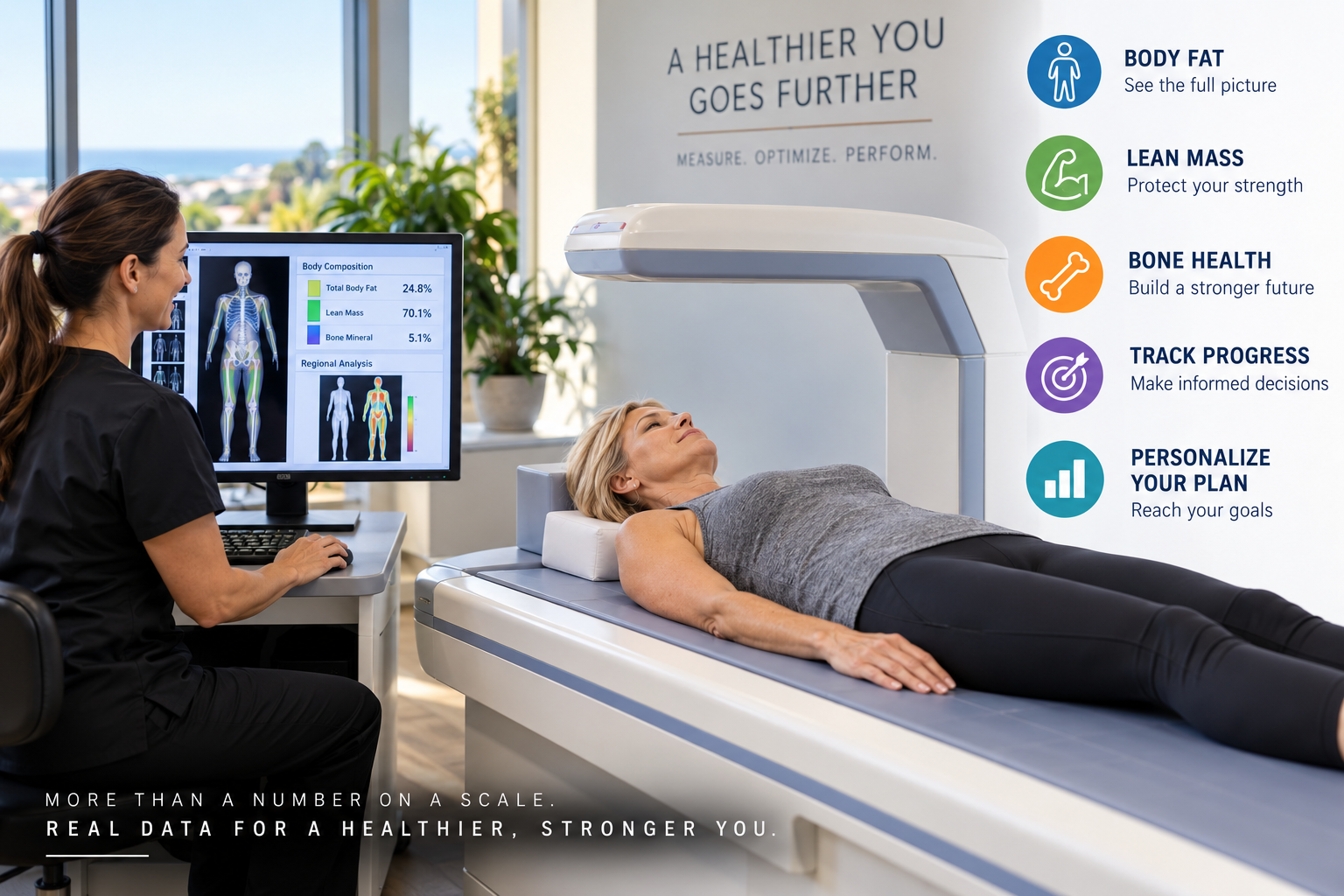
Whether you are an athlete working toward a performance goal, an active adult interested in longevity, or a patient losing weight with a GLP-1 medication, DEXA can help you look beyond pounds lost and focus on the quality of the changes taking place inside your body.
What Is a DEXA Scan?
DEXA—also called DXA—stands for Dual-Energy X-ray Absorptiometry.
DEXA technology uses very low-dose X-rays at two different energy levels to distinguish among different types of body tissue. Although DEXA is widely known for measuring bone mineral density, whole-body DEXA can also provide detailed information about body composition. Unlike your bathroom scale, which combines everything into a single number, DEXA can help differentiate among:
- Fat mass
- Lean tissue
- Bone mineral content
- Regional body composition
- Visceral adipose tissue, depending on the system and analysis used
The result is a more complete picture of your body—and a better way to determine whether changes in weight, training, nutrition, or treatment are moving you toward your goals.
What Can a Whole-Body DEXA Scan Tell You?
Body Fat Percentage
DEXA measures the amount of fat tissue throughout the body and estimates your total body-fat percentage.
Knowing your body-fat percentage provides context that body weight and BMI simply cannot. Two people of the same height and weight may have dramatically different amounts of fat and lean tissue. For patients working toward weight-loss goals, this distinction is particularly important. Losing 15 pounds is not necessarily the same as losing 15 pounds of fat. DEXA helps show what you are actually losing.
Lean Body Mass
Lean mass includes non-fat, non-bone tissues and is an important component of overall body composition. Monitoring lean tissue can be especially valuable for:
- Athletes
- Strength-training patients
- Adults trying to lose weight
- Patients using GLP-1 medications
- Older adults concerned about age-related muscle loss
- People changing their nutrition or exercise programs
- Patients interested in metabolic health and healthy aging
A successful weight-management program should generally focus not only on reducing excess fat, but also on supporting muscle, strength, function, and adequate nutrition.
It is important to understand that DEXA lean mass is not exactly the same thing as skeletal muscle mass, and a reduction in measured lean mass does not automatically mean that a person has developed sarcopenia. Muscle strength, physical performance, nutrition, hydration, medical history, and other factors also matter.
Regional Body Composition
Where you carry fat and lean tissue can be just as informative as how much you have overall.
A whole-body DEXA scan can evaluate different regions of the body, allowing Dr. Sunshine to examine patterns and changes that may not be apparent from total body weight alone. Regional information may be useful for assessing:
- Differences between the arms and legs
- Upper- versus lower-body composition
- Changes associated with training
- Changes during weight loss
- Overall fat distribution
- Lean-tissue balance and symmetry
For athletes, this additional information can help put training progress into a much more meaningful context.
Visceral Fat
Not all body fat has the same implications for health.
Visceral adipose tissue (VAT) is fat located deep within the abdominal cavity around internal organs. It is different from subcutaneous fat—the fat located just beneath the skin. When available through the DEXA system’s analysis, visceral-fat measurements can add useful information to a broader evaluation of metabolic health and body composition. Rather than simply asking, “How much body fat do I have?” we can begin asking a more useful question:
“Where is that fat located, and how is my body composition changing?”
Bone Health
DEXA technology is also used to measure bone mineral density. Depending on the type of DEXA examination being performed and the clinical question, bone measurements can provide valuable information about skeletal health.
Bone health becomes increasingly important with age and can also be relevant for athletes, people experiencing significant weight loss, and patients with other risk factors for low bone density. A dedicated diagnostic bone-density examination and a whole-body body-composition scan are not necessarily interchangeable. Dr. Sunshine can determine which type of DEXA assessment is appropriate when osteoporosis or another bone disorder is a concern.
Why BMI and the Scale Don’t Tell the Whole Story
Traditional weight measurements have limitations.
BMI (Body Mass Index) is calculated using only height and weight. It does not directly measure fat or muscle. That means a muscular athlete may have a relatively high BMI despite having low body fat, while another person with the same BMI could have substantially less muscle and more body fat.
A bathroom scale has a similar limitation.
Imagine that you begin a strength and nutrition program and, three months later, the scale has barely moved. You might assume that nothing is working. But what if you lost eight pounds of fat while gaining six pounds of lean tissue? The scale would show only a two-pound difference.
DEXA gives us the opportunity to look beyond the scale and evaluate body composition—not simply body weight.
DEXA Scans and GLP-1 Weight-Loss Medications
On a GLP-1? Measure More Than Your Weight.
Medications that act on the GLP-1 pathway—including medications containing semaglutide and other incretin-based therapies—have changed the treatment of obesity and weight management. These medications can produce significant reductions in body weight and body fat. However, not every pound lost is necessarily fat.
Clinical research has found that people receiving GLP-1-based therapies may also experience reductions in lean mass during weight loss, although the amount varies considerably among medications, individuals, studies, and measurement methods. Research generally shows substantial reductions in fat mass along with smaller reductions in lean mass, while the clinical significance of these changes depends on factors such as age, health, nutrition, activity, strength, and physical function.
This is one reason that body composition—not simply weight loss—matters.
1. See the Whole Picture
Your scale tells you how much weight you have lost.
DEXA can help show what you have lost.
By measuring fat and lean tissue, DEXA provides information that can help distinguish between reductions in body fat and changes in lean mass. Instead of celebrating—or worrying about—a number on the scale alone, you and Dr. Sunshine can evaluate the composition of that change.
2. Monitor Lean Mass During Weight Loss
Preserving muscle is an important consideration during significant weight loss.
Muscle supports:
- Strength and mobility
- Physical performance
- Independence as we age
- Metabolic function
- Balance and stability
- The ability to exercise and remain active
Some loss of lean tissue commonly accompanies weight loss, whether weight is lost through medication, calorie restriction, lifestyle intervention, or other approaches. Current evidence indicates that lean-mass reductions can also occur with GLP-1 therapies, although fat loss generally accounts for the larger share of weight lost.
DEXA gives you and Dr. Sunshine objective data that can be followed over time.
If lean tissue is declining more than expected, that information can help prompt a broader evaluation of factors such as nutrition, protein intake, resistance training, total calorie intake, recovery, and overall health.
3. Keep Bone Health in the Conversation
Substantial changes in body weight can also make skeletal health an important consideration, particularly in people who already have risk factors for low bone density. DEXA technology is widely used clinically to evaluate bone mineral density. Dr. Sunshine can help determine whether body-composition monitoring alone is appropriate or whether you may benefit from a dedicated bone-density assessment.
4. Track Real Progress
Weight naturally fluctuates because of hydration, food intake, sodium, glycogen, and other factors. That can make the scale frustrating—especially when you are doing everything right. DEXA allows you to look at longer-term changes in:
- Fat mass
- Lean mass
- Body-fat percentage
- Regional body composition
- Other available measurements
This can provide a much clearer picture of whether your overall plan is moving in the desired direction.
5. Personalize Your Weight-Loss Strategy
GLP-1 treatment should not simply be about making the number on the scale smaller.
The goal is to support better health and a healthier body composition. DEXA findings can be considered alongside your medical history, laboratory results, nutritional intake, exercise program, strength, symptoms, and goals. This information may help your healthcare team personalize recommendations regarding:
- Protein and overall nutrition
- Calorie intake
- Resistance exercise
- Cardiovascular exercise
- Recovery
- Weight-loss goals
- Long-term weight maintenance
- Strategies for preserving strength and function
6. Identify Changes Earlier
You cannot reliably see muscle loss in a mirror, and a bathroom scale cannot distinguish muscle from fat. Periodic body-composition testing can reveal changes that might otherwise go unnoticed. That gives you and Dr. Sunshine an opportunity to respond to the type of weight being lost, rather than waiting until a change in strength, performance, or function becomes obvious.
Don’t Just Lose Weight. Improve Body Composition.
The goal of a medically supervised weight-management program is not simply to become lighter. Ideally, weight loss should produce meaningful improvements in health while preserving as much strength, function, and lean tissue as reasonably possible.
For patients using GLP-1 medications, DEXA provides another piece of objective information that can help answer:
- Am I primarily losing fat?
- How is my lean mass changing?
- How is my body composition changing over time?
- Should my nutrition or exercise strategy be adjusted?
- Am I moving toward a healthier, stronger body—not merely a lower number on the scale?
That is a much more useful conversation than simply asking, “How many pounds did I lose?”
DEXA for Athletes and Active Adults
You do not need to be trying to lose weight to benefit from a DEXA scan.
For athletes and active adults, body composition can influence performance, power-to-weight ratio, endurance, strength, recovery, and training strategy. DEXA testing can establish an objective baseline before beginning a new training cycle and provide meaningful comparisons later. It may be especially useful for:
- Endurance athletes
- Cyclists
- Runners and triathletes
- Strength athletes
- Competitive athletes
- Recreational athletes
- People beginning resistance training
- Adults returning to exercise after an injury
- People working toward specific body-composition goals
Instead of relying entirely on appearance, weight, or gym performance, DEXA adds objective data to the equation.
DEXA for Healthy Aging and Longevity
Maintaining a healthy body composition becomes increasingly important as we age.
Over time, adults may gradually lose muscle and bone while gaining body fat—even when their total weight changes very little. That means a stable scale weight does not necessarily mean your body has remained the same. Tracking body composition can help provide a more complete view of changes occurring with aging and can support conversations about:
- Maintaining muscle
- Strength training
- Protein and nutritional needs
- Bone health
- Metabolic health
- Mobility
- Fall prevention
- Long-term physical independence
For patients focused on performance, vitality, and longevity, DEXA can provide valuable objective data for measuring what matters.
Who Should Consider a Whole-Body DEXA Scan?
A DEXA body-composition scan may be helpful if you:
- Are taking a GLP-1 or another medication for weight management
- Are actively losing a significant amount of weight
- Want to know your body-fat percentage
- Want to monitor lean mass while dieting
- Are starting or modifying an exercise program
- Are strength training or trying to build muscle
- Want an objective baseline before beginning a health or fitness program
- Are an athlete interested in optimizing body composition
- Have reached a weight-loss plateau and want more information
- Are concerned about age-related changes in muscle or bone
- Want to monitor changes over time
- Are focused on healthy aging and longevity
- Want more meaningful information than BMI or scale weight can provide
Dr. Sunshine can help determine whether DEXA is appropriate for your particular health goals.
What Happens During a DEXA Scan?
DEXA testing is noninvasive and generally straightforward.
You will lie comfortably on a padded scanning table while the scanner passes over your body. You remain still while the equipment collects the measurements needed to calculate your body composition. There are no injections, enclosed tunnels, or painful procedures. DEXA uses a small amount of ionizing radiation. Modern DEXA systems are designed to use low radiation doses, and no radiation remains in your body after the examination.
Once the scan is complete, the resulting data can be used to help you better understand your current body composition and, when repeated under comparable conditions, changes over time.
How Should I Prepare for My DEXA Scan?
We will provide specific instructions when you schedule your appointment.
In general, you may be asked to:
- Wear comfortable clothing without metal zippers, buckles, or other metal components
- Remove jewelry or other metal objects that could interfere with the scan
- Follow instructions regarding supplements or food before testing
- Tell us about any recent imaging procedures involving contrast material
- Tell us if you are or may be pregnant
Depending on the type of examination, you may be instructed to avoid calcium supplements for a period before your appointment. Recent examinations involving barium, CT contrast, or certain radioisotopes may also affect when DEXA testing should be performed.
For repeat body-composition scans, following similar pre-scan conditions each time can help make comparisons more meaningful.
How Often Should You Have a DEXA Body-Composition Scan?
There is no single testing schedule that is appropriate for everyone.
How often you repeat a DEXA scan depends on why you are being tested, the magnitude and rate of change expected, your medical circumstances, and Dr. Sunshine’s recommendations. The greatest value often comes from looking at trends, rather than repeatedly measuring small short-term fluctuations. A baseline scan provides a starting point. A later scan can then help determine how your body composition has responded to a weight-loss program, GLP-1 therapy, nutrition plan, training program, or other intervention.
Dr. Sunshine can recommend an appropriate interval based on your individual goals.
Understanding Your DEXA Results
Numbers are most useful when they have context.
At OC Sports & Wellness, body-composition information can be considered as part of the larger picture—not simply handed to you as another set of statistics. Depending on your goals, we may consider your DEXA findings alongside factors such as:
- Weight and weight history
- Exercise and training
- Strength and physical performance
- Nutrition
- Protein intake
- Metabolic health
- Medical history
- Medications
- Laboratory findings
- Bone-health risk factors
- Personal health and performance goals
This approach helps turn body-composition data into information that is meaningful for your individual health, performance, and wellness goals.
Frequently Asked Questions About DEXA Body Scans
Is DEXA the same as a bone-density test?
The technology is the same, but the purpose and analysis can differ. A dedicated bone-density examination is generally designed to assess specific skeletal sites for osteoporosis and fracture risk. A whole-body DEXA body-composition scan focuses on the distribution of fat, lean tissue, and bone throughout the body.
Dr. Sunshine can determine which type of examination is appropriate for you.
Is DEXA better than BMI?
They measure different things. BMI is simply a calculation based on height and weight. It does not directly measure body fat or lean tissue. DEXA provides body-composition information that BMI cannot provide.
Is DEXA better than a bathroom body-fat scale?
Consumer bioelectrical-impedance scales estimate body composition using an electrical current and mathematical algorithms. Their readings can be affected by factors such as hydration. DEXA uses X-ray attenuation to differentiate body tissues and provides regional as well as whole-body information. For meaningful follow-up, it is still important to compare scans performed under reasonably consistent conditions.
Does DEXA measure muscle?
DEXA measures lean soft tissue, which is related to—but not identical to—skeletal muscle. This distinction is important. DEXA results should be interpreted together with strength, function, clinical history, and other relevant information rather than treating lean mass as a perfect direct measurement of muscle.
Can DEXA measure visceral fat?
Many modern DEXA systems can estimate visceral adipose tissue in the abdominal region. The specific measurements reported depend on the scanner and software being used.
Is a DEXA scan painful?
No. The scan is noninvasive. You simply lie still on the scanning table while the examination is performed.
Does DEXA use radiation?
Yes. DEXA uses a small amount of ionizing radiation. Radiation exposure from DEXA is low, and no radiation remains in the body afterward.
Can I have a DEXA scan if I’m pregnant?
Tell the healthcare team if you are pregnant or think you could be pregnant. Because DEXA uses X-rays, pregnancy requires special consideration, and the examination may be postponed when appropriate.
Should I get a DEXA scan if I’m taking a GLP-1?
Not every patient taking a GLP-1 necessarily needs DEXA testing. However, body-composition assessment can provide useful information for patients and clinicians who want to monitor fat and lean tissue during substantial weight loss.
Can DEXA tell me whether my GLP-1 medication is working?
DEXA does not determine whether a medication is medically appropriate or effective by itself. It provides additional information about changes in body composition. Dr. Sunshine will evaluate those results together with your weight, health markers, medication response, side effects, nutrition, activity, and overall goals.
Is losing lean mass on a GLP-1 dangerous?
Not necessarily. Some reduction in lean mass commonly occurs during significant weight loss, and DEXA-measured lean mass is not synonymous with skeletal muscle or muscle function. The amount of lean tissue lost, a patient’s age and health, strength and physical function, nutritional intake, activity level, and other factors all matter.
Measure What Matters
Your Weight Is Only One Number. Your Body Tells a Bigger Story.
Whether you are losing weight, using a GLP-1 medication, building strength, training for competition, or simply investing in a healthier future, understanding your body composition can help you make better-informed decisions. A Whole-Body DEXA Scan gives you objective information about fat, lean tissue, regional body composition, and bone—information a bathroom scale simply cannot provide.
At OC Sports & Wellness, we believe better decisions begin with better information.
Don’t guess. Measure. Optimize.
Schedule Your Whole-Body DEXA Scan
Take a closer look at what is happening inside your body and gain objective information you can use to guide your health, fitness, or weight-management goals.