VO₂ Max Testing for Athletes:
Know Your Engine, Train With Purpose, and Perform at Your Best
Athletes spend countless hours training their bodies to become stronger, faster, and more resilient. But even the most dedicated training program leaves an important question unanswered:
How efficiently is your body actually producing the energy you need to perform? VO₂ max testing helps answer that question.
What Is VO₂ Max Testing?
VO₂ max—short for maximal oxygen uptake—is a measurement of your body’s ability to take in, transport, and use oxygen during increasingly demanding exercise. It provides an objective assessment of cardiorespiratory fitness and the capacity of your heart, lungs, circulatory system, and working muscles to function together under high physical demands.
For athletes, that information can be tremendously valuable. Rather than relying entirely on pace, perceived effort, generic heart-rate formulas, or numbers generated by a fitness watch, metabolic testing provides data based on your individual physiology.
And VO₂ max isn’t relevant only to marathon runners, cyclists, or other endurance athletes. Aerobic fitness also plays an important role in sports involving repeated bursts of intense activity.
Why Aerobic Fitness Matters—Even When Your Sport Isn’t “Aerobic”
Think about what happens during soccer, basketball, tennis, pickleball, hockey, martial arts, or many other sports. An athlete accelerates, sprints, changes direction, jumps, competes intensely—and then has a relatively brief opportunity to recover before doing it again.
Those explosive movements rely heavily on the body’s anaerobic energy systems. But the ability to recover and prepare for the next effort is strongly influenced by aerobic fitness.
A study of professional soccer players published in The Scientific World Journal examined the relationship between VO₂ max and repeated sprint ability. Researchers found a significant relationship between relative VO₂ max and repeated sprint performance. Their conclusion was particularly important: aerobic capacity appears to be an important factor in helping athletes recover between repeated sprint-type activities. In other words, your aerobic system isn’t simply responsible for helping you run farther.
It can help you come back stronger for the next effort.
That distinction matters for athletes whose sports demand repeated periods of high-intensity work.
How VO₂ Max Reflects Your Aerobic Capacity
During exercise, your muscles require oxygen to produce energy aerobically. As exercise becomes more demanding, oxygen requirements increase.
Your VO₂ max represents the upper limit of your body’s ability to consume and use oxygen during intense exercise. A higher VO₂ max generally reflects a greater capacity to deliver oxygen to working muscles and use that oxygen to produce energy. For an athlete, that can contribute to the ability to sustain demanding exercise, perform more work aerobically, and recover between intense efforts.
But VO₂ max shouldn’t be viewed as a score you either “pass” or “fail.” It is better viewed as a physiological benchmark—one that can help you understand your current fitness and establish a starting point for improvement.
Benefits of VO₂ Max Testing for Athletes
VO₂ max testing can provide athletes with much more than a single fitness number. When evaluated as part of a comprehensive metabolic assessment, the results can help provide greater insight into training intensity, aerobic capacity, recovery, and changes in fitness over time.
More Personalized Training Zones
Many athletes train according to heart-rate zones. The problem is that commonly used formulas are based on population averages. Two athletes of the same age can have dramatically different cardiovascular responses to exercise. Metabolic testing can reveal what is happening inside your body as exercise intensity changes.
During a comprehensive VO₂ max assessment, oxygen consumption, carbon dioxide production, ventilation, heart rate, and exercise intensity can be evaluated together. This information can help identify physiological thresholds and establish more individualized training intensities. Instead of assuming where easy, moderate, threshold, and high-intensity training should occur, testing can provide objective information to help guide those decisions. That can make workouts much more purposeful.
Easy days can actually be easy. Hard days can be appropriately hard. And every workout can have a clearer objective.
Smarter Training Instead of Simply Training Harder
More exercise isn’t automatically better exercise. One common challenge among recreational athletes is spending too much training time at an intensity that is harder than necessary for recovery or aerobic development, yet not sufficiently demanding to produce the adaptations targeted by a true high-intensity session. The result can be a great deal of fatigue without the expected improvement.
Knowing your individual physiology can help you and your healthcare or training professional develop a more intentional approach to exercise intensity. For some athletes, testing may reveal that their easy workouts have actually been too hard. Others may discover they can work harder than they realized during appropriate training sessions. Both discoveries can be useful. The goal isn’t simply to exercise harder. It’s to exercise smarter.
Better Recovery Between High-Intensity Efforts
Research on professional soccer provides an excellent example of why aerobic capacity matters to athletes who repeatedly accelerate and sprint. The researchers concluded that athletes with greater relative VO₂ max tended to perform better across repeated sprint efforts. They proposed that stronger aerobic capacity may assist recovery processes between intense bouts of exercise, including restoring energy stores needed for subsequent muscular work. That has implications extending beyond soccer.
Consider the repeated demands of:
- Tennis and pickleball points
- Basketball transitions
- Hockey shifts
- Lacrosse
- Rugby
- Combat sports
- Interval-based training
- Cross-training competitions
- Court sports
- Repeated hill or sprint workouts
Performance isn’t determined solely by how explosive your first effort can be. Often, what separates athletes is their ability to produce another strong effort—and another—while fatigue accumulates. Recovery is part of performance. Aerobic fitness helps support that recovery.
An Objective Baseline for Measuring Progress
Athletes measure almost everything: miles, steps, pace, watts, repetitions, weight, heart rate, sleep, and recovery. But without physiological testing, it can sometimes be difficult to know whether all that work is creating the desired adaptations. VO₂ max testing establishes an objective baseline. After an appropriate period of training, repeat testing can help answer an important question:
Is your body actually becoming more aerobically fit?
Changes in VO₂ max and other metabolic measurements can provide meaningful information about how your body has adapted to training. This makes testing useful not only for competitive athletes but also for recreational athletes, active adults, and people returning to fitness who want measurable goals. Progress doesn’t always show up on a bathroom scale. Sometimes progress means producing more power at the same physiological cost. Sometimes it means sustaining exercise longer. Sometimes it means recovering more effectively. And sometimes it means simply having more energy to do the things you love.
VO₂ Max Is Important—but It Isn’t the Whole Story
Athletic performance is complex. VO₂ max cannot tell you everything about your fitness, and a high VO₂ max does not automatically make someone a great athlete. Strength, power, coordination, movement efficiency, body composition, sport-specific skill, nutrition, recovery, genetics, and psychological factors all contribute to performance. That’s precisely why evaluating VO₂ max alongside other meaningful physiological measurements can be so useful. Instead of looking at a single number in isolation, a comprehensive assessment can provide a more complete picture of the person behind the performance.
Comprehensive Metabolic Assessment at OC Sports and Wellness
At OC Sports and Wellness in Orange County, we believe performance and long-term wellness are about more than a single metric. That’s why we’re offering comprehensive metabolic assessment packages designed to give men and women actionable information about their bodies, fitness, metabolism, strength, and body composition. Depending on the assessment package, testing can include:
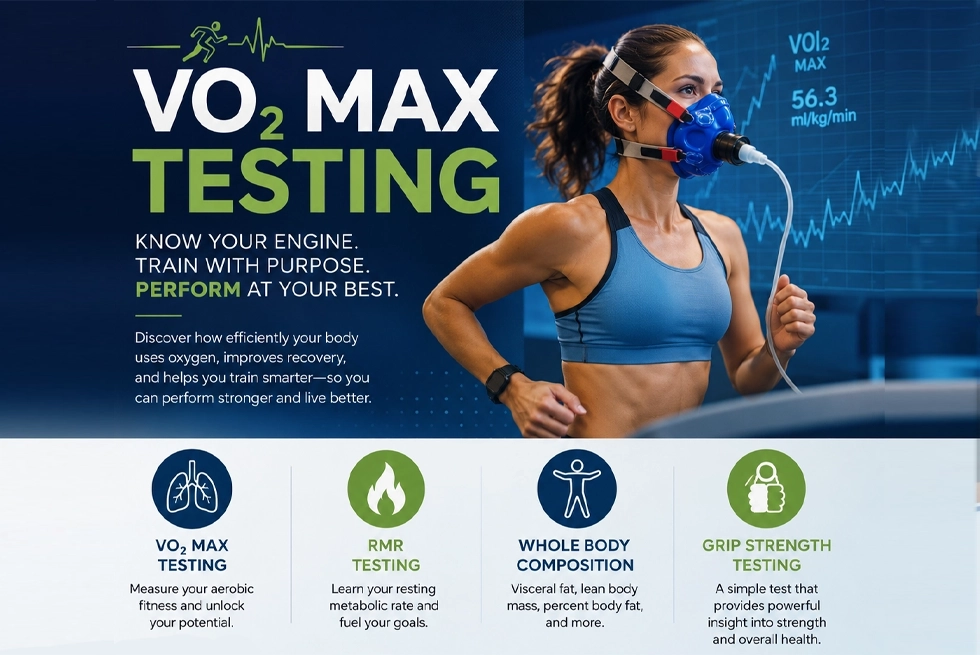
VO₂ Max Testing
Evaluate cardiorespiratory fitness and gain greater insight into how efficiently your body uses oxygen during exercise. VO₂ max testing can also provide valuable information for establishing individualized exercise intensities and monitoring changes in aerobic fitness.
Resting Metabolic Rate (RMR) Testing
Learn how much energy your body requires at rest. Understanding your individual resting metabolism can provide a more informed foundation for nutrition, body composition, performance, and weight-management strategies.
Whole Body Composition Testing
Go far beyond body weight alone with measurements that provide insight into areas such as visceral fat, lean body mass, body fat percentage, and overall body composition.
Grip Strength Testing
Grip strength provides a simple but meaningful objective measure of muscular strength and physical function that can be followed over time.
Together, these measurements can provide a multidimensional view of your current health and fitness.
Turn Your Results Into a More Informed Plan
Data is most valuable when you can do something with it. For the competitive athlete, metabolic assessment may help guide more individualized training and provide objective benchmarks for future improvement. For the recreational athlete, it may reveal opportunities to improve endurance, recovery, strength, or body composition.
For someone focused on healthy aging, the goals may differ but remain equally meaningful: preserving muscle, maintaining strength, improving cardiovascular fitness, supporting metabolic health, and continuing to participate fully in the activities that make life enjoyable. That is ultimately what these assessments are about. Not chasing a perfect number. Not comparing yourself with someone else. They’re about understanding where you are today so you can make informed decisions about where you want to go next.
Your Fitness Is More Than How You Look
Two people can weigh exactly the same and have very different levels of muscle mass, visceral fat, cardiovascular fitness, strength, and metabolic health. That’s why a scale—or even a mirror—can tell only a small part of the story. VO₂ max testing, RMR testing, whole-body composition analysis, and strength assessment provide something different:
Objective information about how your body is functioning.
- For athletes, that knowledge can help turn training from guesswork into a more individualized process.
- For active adults, it can establish measurable benchmarks to improve fitness and maintain physical capability over time.
- And for anyone who wants to remain active as the years pass, it provides an opportunity to focus on something much more meaningful than simply getting older:
Building the capacity to keep living well.
Who Can Benefit From VO₂ Max and Metabolic Testing?
You don’t have to be an elite athlete to benefit from understanding your physiology. VO₂ max and metabolic testing may be valuable for people who are:
- Training for a marathon, half marathon, triathlon, cycling event, or endurance competition
- Trying to improve performance in tennis, pickleball, soccer, basketball, hockey, or other intermittent sports
- Working to improve cardiovascular fitness or endurance
- Returning to structured exercise after time away
- Interested in more individualized heart-rate and exercise intensity guidance
- Working toward changes in body composition
- Interested in establishing measurable fitness and strength benchmarks
- Focused on maintaining strength, mobility, cardiovascular fitness, and independence as they age
Your goals are personal. Your physiology is personal too.
Measure What Matters. Then Build From There.
At OC Sports and Wellness in Orange County, our comprehensive metabolic assessments help provide the objective information you need to better understand your cardiovascular fitness, metabolism, body composition, and strength. Whether your goal is to improve athletic performance, train more efficiently, understand your metabolism, maintain muscle, or build a stronger foundation for lifelong health, knowing where you are today can help you make more informed decisions about tomorrow. Because the ultimate goal isn’t simply to perform better today.
It’s to build a body capable of carrying you toward the experiences, challenges, adventures, and life you want tomorrow.
Frequently Asked Questions About VO₂ Max Testing
What does VO₂ max testing measure?
VO₂ max testing measures your body’s ability to take in, transport, and use oxygen during increasingly intense exercise. It is commonly used as an objective measure of cardiorespiratory or aerobic fitness.
Is VO₂ max testing only for endurance athletes?
No. Although VO₂ max is especially relevant to endurance sports, aerobic capacity also contributes to recovery between repeated high-intensity efforts. This can make testing valuable for athletes in sports such as soccer, basketball, tennis, pickleball, hockey, and other activities that alternate between intense effort and short recovery periods.
How can VO₂ max testing improve my training?
VO₂ max testing can provide individualized information about how your body responds to increasing exercise intensity. This data may help establish more personalized training intensities, evaluate aerobic fitness, and provide an objective baseline for tracking changes over time.
Can VO₂ max testing help determine heart-rate training zones?
Metabolic exercise testing can provide information about heart rate and physiological responses at different exercise intensities. This can offer a more individualized approach to training than relying solely on age-based heart-rate formulas.
What is the difference between VO₂ max and RMR testing?
VO₂ max testing evaluates how your body uses oxygen during exercise and provides information about aerobic fitness. Resting Metabolic Rate (RMR) testing measures how much energy your body uses at rest. Together, the tests provide different but complementary information about exercise physiology and metabolism.
Why combine VO₂ max testing with body composition testing?
VO₂ max assesses aerobic fitness, while whole-body composition testing provides measurements such as lean body mass, body fat percentage, and visceral fat. Looking at these measurements together can provide a broader picture of fitness and physical health than body weight alone.
Why is grip strength included in a metabolic assessment?
Grip strength provides an objective measurement of muscular strength and physical function. When combined with metabolic and body composition testing, it adds another useful benchmark that can be monitored over time.
Where can I get VO₂ max testing in Orange County?
OC Sports and Wellness in Orange County offers comprehensive metabolic assessment packages that can include VO₂ max testing, Resting Metabolic Rate testing, whole-body composition analysis, and grip strength testing for men and women interested in athletic performance, fitness, and an active lifestyle.
Research Reference
Aziz AR, Mukherjee S, Chia MYH, Teh KC. Relationship between measured maximal oxygen uptake and aerobic endurance performance with running repeated sprint ability in young elite soccer players. The Scientific World Journal. 2013;2013:952350.
We hope this information is helpful. At OC Sports and Wellness in Orange County, we understand the importance of balancing your health with a busy lifestyle. That’s why we offer convenient options for scheduling visits, texting, or video chatting with Dr. Sunshine. Let’s work together towards your well-being! Reach out to us at 949-460-9111.

Disclaimer: The information above is educational and not a substitute for personalized medical advice. Outcomes vary. Always consult a qualified healthcare professional to determine the best treatment for your condition.